Humans are the only species to show a strong bias in handedness, with around 90% of people being right-handed. The cause of this bias remains largely a mystery .Researchers haven’t quite figured that out yet, but some believe it’s a complex collaboration between genes and environment. There isn’t a distinct gene that indicates left-handedness; however, there is a difference between brain capabilities in righties and lefties.
A genetic study has identified a biological process that influences whether we are right-handed or left-handed. Scientists found correlations between handedness and a network of genes involved in establishing left-right asymmetry in developing embryos.The most strongly associated, statistically significant variant with handedness is located in the gene PCSK6, which is involved in the early establishment of left and right in the growing embryo.
The connection between the left brain and the right brain is "somewhat larger and better connected in left-handers. So what does this mean? It could mean that left-handers have a slight advantage in sports, gaming and other activities in which players face large volumes of stimuli being thrown at them simultaneously or in quick succession. Theoretically, they could more easily use both hemispheres of the brain to manage that stimuli, resulting in faster overall processing and response time.
It could also mean that when one hemisphere of the brain got overloaded and started to slow down, the other hemisphere could more easily pick up the slack without missing a beat. Experts also theorize that left-handed people could fare better mentally as they move into old age and overall brain processing starts to slow down: With a greater ability for one brain hemisphere to quickly back up the tasks of the other, left-handed seniors could retain mental quickness longer than their right-handed counterparts.
Some researchers believe lefties are capable of more complex reasoning, which is why there's a particularly high number of lefty Noble Prize winners, artists, writers, architects, musicians, and mathematicians. Others theorize that lefties are forced to find solutions in order to survive in a right-dominated world, which means they experience extra mental resilience.
Strengths of Righties vs. Lefties
Right-handed AKA left-brained people tend to be have higher
Rhythm (Beats),Non-verbal expression,Expressing feelings,Visualization,Remember the tune of songs,Daydreaming.
Yet a number of questions remain, including whether there are selective advantages for right over left handedness that are strong enough to explain why almost the entire human species skews to the right, and is such advantages exist, why 15% of humans remain stubbornly left-handed.The handedness mystery continues!!!
I'm sitting in front of my Laptop after a weeks of Time thinking of what to write in my blog for today.As I gather my thoughts, I notice my emotional state: content, calm and peaceful. I am struck by the irony. Sitting here preparing to write about gratitude, I realize that is exactly what I am feeling today.Although we may acknowledge gratitude’s benefits, it can still feel difficult to feel grateful when we are going through a difficult time. That’s why it makes so much sense to practice gratitude, in good times and bad. It may be human nature to notice all that is wrong or that we lack, but if we give ourselves the chance on a regular basis to notice all of life's gifts and blessings, we can increase our sense of well-being, and create hope and optimism for the future no matter what is going on.
Some children were playing beside a river. They made castles of sand and each child defended his castle and said, “This one is mine .” They kept their castles separate and would not allow any mistakes about which was whose. When the castles were all finished, one child kicked over someone else’s and completely destroyed it. The owner of the castle flew into a rage, pulled the other child’s hair, struck him with his fist and bawled out, “He has ruined my castle! help me punish him as he deserves. The others all came to his help. They beat the child with a stick and then stamped on him as he lay on the ground. . . Then they went on playing in their sand-castles, each saying, “This is mine; no one else may have it. Keep away! Don’t touch my castle!”
But evening came; it was getting dark and they all thought they ought to be going home. No one cared what became of his castle. One child stamped on his, another pushed his over with both his hands. Then they turned away and went back, each to his home.Behaviors resonate for centuries for both children and adults. Today’s prized possessions and cherished ambitions are yesterday’s sand-castles. What is left?
One small thing you should do every day-show your gratitude, appreciation and love for the people and things around you.find something you are appreciative of or find something you are grateful for.Did you know that appreciation, gratitude and love are the highest forms of vibration?" "You can only have one vibration at a time, and if you are noticing what you appreciate and noticing what you are grateful for, you can't be noticing what you don't like."Decide today that you are going to reduce negativity in your life by getting rid of the 'don'ts,' 'nots' and 'no's'-the negative people, the negative thoughts,Get in the habit of appreciating things."
If the only prayer you say in your life is ‘thank you,’ that would suffice. – Meister Eckhart
Thank Everyday's Gift
People tend to take for granted the good that is already present in their lives. There’s a gratitude exercise that instructs that you should imagine losing some of the things that you take for granted, such as your home, your ability to see or hear, your ability to walk, or anything that currently gives you comfort. Then imagine getting each of these things back, one by one, and consider how grateful you would be for each and every one. In addition, you need to start finding joy in the small things instead of holding out for big achievements—such as getting the promotion, having a comfortable nest egg saved up, getting married, having the baby, and so on–before allowing yourself to feel gratitude and joy.
Another way to use giving thanks to appreciate life more fully is to use gratitude to help you put things in their proper perspective. When things don’t go your way, remember that every difficulty carries within it the seeds of an equal or greater benefit. In the face of adversity ask yourself: “What’s good about this?”, “What can I learn from this?”, and “How can I benefit from this?”
Start practicing gratitude to improve your well-being
1.Keep a gratitude journal. At the end of each day, write down 3-5 things from the day you feel grateful for. Simplicity is key. Your baby’s smile, a perfect sunset, the train arriving on time, or your best friend’s laughter. Relish the feeling you get when remembering and writing it down.
2.Express your gratitude. Take the time to share your feelings. Not the simple, polite thank you, but the heartfelt emotions. Tell your friend how her support and sense of humor helps you get through tough times, and how much it means to you. Don’t take your loved ones for granted. Let them know how much you love them and why.
3.Look for what is right about a situation, not what’s wrong. Sure you’re frustrated by the bus being late, but thankfully you have an understanding boss. Service at the restaurant is poor, but you are lucky to afford an evening out surrounded by good friends.
4.Practice gratitude with your family and friends. Although you may not say grace before a meal, encourage each family member to report one thing that happened that day that they feel grateful for. When you hear a friend moaning and complaining, challenge him or her to find the hidden opportunity or silver lining to the situation.
Often times we get so busy with chasing after the things we want, after the things that are somewhere out there, that we forget to enjoy the present moment, we forget to be happy. You hear people all the time saying: Oh, I will be happy when I will get this and that, when I will get there, when I will do this and that… and when those things do happen, they go on to planning the next thing and the next thing and forget to enjoy the things they achieved so far, the things they longed for. By doing so people also forget to enjoy what they already have, they forget to be happy. Don’t let that be you.
“Be thankful for what you have; you’ll end up having more. If you concentrate on what you don’t have, you will never, ever have enough.”
Realize that now, in this moment you have more than enough. It’s okay to have dreams, it’s okay to aspire to grow, to learn, to evolve and to achieve big things but it’s also important to celebrate yourself, to celebrate your accomplishments, to celebrate the present moment and to celebrate your life. With gratitude comes happiness and with happiness comes gratitude!!!!
One day, some youths went to a jungle to practice shooting. They kept few pots at a distance and targeted them. None of them could hit even a single pot.
A saint who was watching them started laughing. One of them went to him and asked, "Why are you laughing? Do you know how to shoot?"
At this, the saint took the gun and fired at the pots and smashed all of them one by one. The youths were amazed to see this and asked the saint if he was a magician.
The saint replied, "I am neither a magician nor a sharpshooter. I just concentrated and the result is in front of you. One should always work with concentration."
You might have heard this as a Bed time story in your Child hood several times.And would have started sleeping happily.Is it that much easy to bring Concentration and complete our Tasks?
Focus Vs Brain
Focusing on a task is a lot like focusing your vision. It is essentially a top-down process. When you make the decision to focus on something, your brain first takes in all the visual information and starts to process that information to tell you what you should focus on. It’s like looking at a painting or a photograph for the first time. When the image becomes clearer, then your brain will move in on one aspect that you want to pay attention to. When you achieve that blissful kind of concentration where time slips by you, your perception of the world around you changes, allowing you to have a heightened ability to ignore outside stimuli.
How we Lose Focus?
Look at the following familiar situation. You need to study something for your job or for an exam. You sit comfortably on the sofa with the book in your hands and start reading. After a while you feel hungry and go to the kitchen to eat something.You return to read, and then hear you people talking outside. You listen to them for several moments and then bring your attention back to the book.After a while you feel restless and switch on the radio to listen to some music. You continue to read for a little while, and then remember something that happened yesterday, and you start thinking about it.When you look at your watch, you are amazed to find out that one complete hour has passed and you have hardly read anything.This is what happens when one lacks concentration. Imagine what you could have accomplished, if you could control your attention and focus your mind!
Train yourself to stay focused - Pomodoro Technique
No one can magically become more focused. It actually takes a lot of work, and it requires one of the hardest types of effort: mindfulness. However, there are tips and techniques that you can apply as you’re training yourself to become more focused.
The Pomodoro Technique is a time management process developed by Francesco Cirillo in 1992 to help him get more studying done. It uses a timer to break down periods of work into 25-minute intervals that are separated by 5 minute breaks. After 4 work periods you take a long 15-20 minute break. The process can be summarized by the following steps:
Choose a task-Set the timer to 25 minutes, and start working-Record progress at the end of the 25 minutes-Take a 5 minute break (15-20 minutes after 4th work period)
The technique’s author named it after the tomato shaped kitchen timer he used to keep track of his work (‘pomodoro’ is a tomato in Italian).Breaking down work into small chunks is generally a good idea; it is easier to estimate what can get done in 25 minutes, and much easier to control the urge to procrastinate when you have a very limited time to complete your task. The regular breaks also keep you feeling fresh and focused.Overall, the technique works well in certain situations but not all. Use it to get started on a new project or task that you keep putting off. Getting started is usually the hardest part, and the Pomodoro technique is a great way of getting over that inertia. If you are being productive on your own, don’t break the momentum you have with regular breaks.
Meditate
Meditation can be like training your mind’s muscles to stay focused, because it helps you become more single minded. It’s not really about sitting still for hours, especially if you’re just starting out. It can be as simple as closing your eyes and vividly imagining yourself eating an apple, taking the bites out of it and focusing on the sensations. Before you know it, 10 minutes have passed while you channelled your focus toward one thing only.
Music may be considered the language of the soul. It is probably the easiest meditation technique to use for beginners. There is a simple principle when readying oneself to meditate with music. a wide variety of music is available to us, but the most important characteristic of music for meditation, is that it is music of the heart.Music is created and performed from differing elements of our human psyche. some music is very emotional, or dry and intellectual or even aggressive and physical. Since the goal of our meditation lifestyle.
Take tech vacations
A big reason for our attention deficit as a society is technology. When your brain is confronted with two tasks that are seemingly on the same level of importance, it will choose the easier one, and technology is almost always the easier one. Even if it’s impossible to take a tech vacation because of what you do, try to be mindful of your relationship with tech. Staying connected, but have limits. Use apps thate take the edge off your online life.
“What is important is seldom urgent and what is urgent is seldom important.” - Dwight D. Eisenhower
We have a tendency to focus on the urgent activities, without leaving enough time for to focus on the truly important tasks. This kind of busy work simply means we’re keeping our head above the water and firefighting through our to-do lists. But the meaningful things that actually lead to accomplishments are the important ones.
Task Management - The Urgent Important Matrix
Quadrant 1: Urgent/Important
Highest priority. Try to keep this list empty. If you spend too much time here, you are working solely as a trouble shooter, and never finding time to work on longer-term plans.
Quadrant 2: Not Urgent/Important Quadrant
This is where you want to spend most of your time; working on something important and have the time to do it properly. This will help you produce high quality efficiently.
Quadrant 3: Urgent/Not Important Quadrant
Consider for elimination. This is where you are busy but not productive. Tasks in this quadrant are often mistaken to be important.
Quadrant 4: Not Urgent/Not Important Quadrant
Minimize. Often we “escape” to this quadrant for survival after spending too much time in quadrants 1 and 3. This may cause quadrant 2 activities to get pushed aside until they become urgent and move to quadrant 1 — at which point its too late to do them effectively.
Using this technique for prioritization allows you to deal with the truly urgent while working towards your goals. This is where you plan properly, execute well and enjoy a stress free productive environment. However, adopting this matrix to manage your tasks is quite difficult without a properly designed application. Neither pen & paper nor traditional software (e.g word processor, spreadsheets) work well in grids.
Find your motivation – the big ‘why’
One of the reasons we can’t stay focused is fuzzy motivation. We don’t know why we’re doing what we’re doing. This can be low-level – when you’re unclear why a specific task will help achieve a goal – or high-level – why you’re trying to achieve that goal in the first place. When your motivation is clear, then your attitude will change and you will transform how you work. When you are truly interested and passionate about what you do, concentration is surprisingly easy.
Lightning strikes in a moment with force and sound. Then it is over and there is no way to hold on to it.
What is the source of lightning? Where does it come from? Why does it jump from clouds? A meteorologist can give an answer. “It’s due to a combination of air currents in the clouds, ice particle colliding, and temperature changes.” Sounds reasonable—but it does not get to the crux of the matter. It is just an explanation. But still we listen to the words and repeat them often enough to believe them to be the fact. The words don’t reveal where the lightning comes from, or even what it is. The fact is that no one knows where lightning comes from.
Our life is like this. We shine brightly for the moment. We can have stories about where we come from, whether it is the birth of an individual or the birth of the universe. But these words are just explanations also. Again, no one knows. We just say it. We are just here.
But we have been given the gift to be born humans—to have the capability to raise questions that go directly to our nature–Who am I? Why? What?
But more, we are fortunate to have the time and opportunity to explore, not explain, these questions. The time is now. The opportunity is our practice. Quieting the mind and bringing attention back to the moment, is at the heart of the practice. This practice begins to loosen the attachment to words and explanations. It allows us to raise the energy needed for transformation and to have an active insight into our nature.
Active insight expresses itself directly and usefully in all of our activities — work, taking care of others, cleaning, eating.This is the opportunity and time. It is ours to make the most of it.Life is not simple we have lot of things around us to take care.Our family,friends,appointments,Our commitments, Goals etc., But how we keep Good Balance between all these things and enjoy what the world has offered us Reveals the secret of Happiness.
Some of us fix goals for being happy.There is no doubt that clearing clutter will give you the time and space you need to fully embrace life, but you don’t have to wait for an empty drawer to get started. I know you think you will be happy when you are debt free, or happy when you get your long time expected promotion, but I can tell you with great conviction that it’s time to be happy right now.we need to appreciate the beauty that surrounds us while staying focused on what is most important to us.
Run around with a crazy smile on your face and rainbows shooting out of your pockets, but once you believe that happiness is possible, regardless of your current circumstances, things will start to change. You will change. Your life will change. You will be happy.Happiness is a butterfly you should learn the secret to pursue it
Over and over I have heard the saying, “God doesn’t give you more than you can handle.” There are days that we wonder is life worth living if we have to get up every day and fight to be strong? We look enviously at others who seem to not struggle and wonder why God seems to bless those that can handle so little, and curse those of us who are so strong.Let me tell you something that may come as a surprise. God does give us more than we can handle. Every day He may place us in the position where the pain is too much to bear. Why? Because we were never meant to do this life without Him! He gives you more than you can handle–but not how much you and He–together–can handle.
There will be days when you may wake up and think, I can’t do this. I cannot keep living this way. Why is life worth living if I can’t meet the expectations of others or even myself? I cannot figure out how to get rid of this darkness that haunts me.I cannot Manage.I cannot Handle.
Olympic runner Marla Runyan never let her disability slow her down. Born in 1969 in Santa Maria, California, Runyan has Stargardt’s disease, a degenerative eye condition that caused her to become legally blind. A three-time national champion in the women’s 5000 meter, Runyan competed in the 1500-meter finals at the 2000 Olympics in Sydney, Australia.
The most famous visually-impaired person of all time was Helen Keller, a woman who overcame virtually insurmountable obstacles to live not only an ordinary life, but an extraordinary one.
During her lifetime, Keller traveled the world, met 12 presidents, received several honorary doctorate degrees and countless awards, including the being elected to the Women’s Hall of Fame. In 1962, Keller and Sullivan’s story was made into an Oscar-winning movie with “The Miracle Worker.”Known for her inspiring speeches about overcoming all obstacles.
It is not necessary that only History /Internet/Books can teach you about people who have struggled enough to come up in their life.If you look at the world around you with wider lens there are people who struggle in their day to day life to come up....who can make you stronger enough to face your problems who can definitely change your though process.
One fine Monday I was waiting for bus,I heard some one asking me for bus directions I turned It was a Lady ,she asked me to inform her once the straight bus to Porur comes.Near by her husband was standing he was also blind.Within few minutes their bus came I informed her and I tried to help her to board the bus she denied in Gentle way and replied back“We can manage”.I too got into the same bus and saw people were quietly watching them no body was ready to offer a seat.I was about to request a person to get up and give seat for them..but the lady interrupted me and said..itz fine“We can handle..we are used to it…we can get through this crowd”.They both had a bright smile in their face after some time the blind couple got down and started walking on the road happily chit chatting. All she expected from me was the confirmation of bus number alone!Nothing else!
When some one whom we depend upon so much denies to help us we immediately feel bad and Dejected. We always think /bother about the temporary darkness in our life..but there are people with permanent darkness still they are able to maintain a bright smile in their face..When you change your glasses you can look at brighter side of the world..But these people have no Glasses to look at the brighter side of the world but yet they visualize it through their will power,self determination,confidence.“Character cannot be developed in ease and quiet. Only through experience of trial and suffering can the soul be strengthened, ambition inspired, and success achieved.”
Do you know that your dreams can give you real insight into what is going on inside you? That you have several dreams a night, even if you don’t remember them? That they show you stories about yourself in a kind of metaphor language that is easy to learn? That they can become your own inner counsellor, giving you continuous feedback on your life? One interesting type of dream is that in which we are communicating with others on some level. If you wake up and feel that you were having a discussion or communicating with someone you know, you may, in fact, have truly been doing just that. In these communication dreams – or communication experiences – the person being engaged in dialogue can be living or “dead.” Some communication can come in the form of guidance and can be coming from our spirit guides (or guardian angels, angelic presences, or whatever terminology you wish to use).
Some dreams are “psychic” dreams, in which we receive information we have no other concrete way of knowing. These include precognitive dreams that can give us information about the future, as well as clairvoyant (French for clear-seeing) dreams that can give us glimpses of things going on in the “real world” while we are dreaming. Some dreams are mainly expressing fears or desires we may have, especially those that may be lying below our conscious awareness. These dreams serve to make us consciously aware of these fears or desires so that we may work on them, and these dreams may also represent our actually working on these issues at an unconscious level.
Believing that you have seen the future in a dream is surprisingly common, with recent surveys suggesting that around a third of the population experience this phenomenon at some point in their lives.
In 1865, two weeks before he was shot dead, Abraham Lincoln had a psychic dream about a funeral at the White House. In the dream, he asked someone who was in the casket and they replied, "the president of the United States". He told his wife about the dream but neither of them took it to heart - for on the night of his assassination he gave his bodyguard the night off.
When the Titanic sunk in 1912, hundreds of people came forward with reports of psychic dreams about the demise of the great ship. Amazingly, it was possible to validate at least 19 of them, including one date-stamped letter.
Extensive research has been done to explore the various facets of precognitive dreaming. It has been observed that precognitions are associated with that part of the brain which controls feelings. It has been found that individuals with a creative bent of mind receive precognitions of better clarity. Also, the rate of those precognitions turning true is higher in creative people. It is also observed that individuals who practice yoga or meditation on a regular basis receive clearer precognitions of the future and the rate of those turning true is again higher in them. This means, you have chances of receiving precognitions about things you are best tuned to. Greater emotional involvement in someone or something leads your mind to imagine future occurrences pertaining to that person or object, which might give you a feel of having precognitions about them. And they may turn true; sometimes for occult reasons, sometimes for reasons clearly seen and at times, it's sheer coincidence.
Being deeply involved in a situation increases the chances of having precognitions about its outcome. If you want to know about the outcome or future of something, merely expecting precognitions won't work. Instead, sleep over the thought, register it deeply in your mind, and your subconscious will start processing the thought. The next morning, the answer or idea might just come to you through, what could be called a precognitive dream.
The fact that a lot of your dreams come true, does not mean that all dreams come true. I theorize that our subconscious is connected to a common conciousness, but for all we know, it is all in our heads. And even if it isn't all in our heads, and we get impressions from a source outside of ourself, it would all be interpreted by our mind, with the initial idea possibly lost or warped in translation. In addition, our minds are infinitely creative and full of ideas and imagery that would either overshadow other impressions, or mingle with them, making it impossible to tell fact from fiction.
Most people grow up learning to ignore and question things as gut feeling/intuition and mystical profound thoughts/ideas/experiences. As a result, we don't know how to listen to these things, and I believe that one has to be careful when one starts listening, as paranoia, fears and other unhealthy thoughts from one's subconscious can disguise themselves as truths, omens, things to consider, things to be afraid of.
Have you ever looked at a 2-inch thick book you want to read but just the thickness of it discourages you from even wanting to begin to read?This is the reason why I believe in focusing on the positive of the outcome such as the knowledge you will get, not in the thickness of the book!
Same thing happens with any other objectives or goals, we look at the many things we need to do instead of the positive outcome it will bring us.You are looking at the multitude of processes you need to get done to achieve your objective!Look and concentrate on the end result instead!Imagine it, see it as done and feel as if you have already achieved it.Do this and you will be on your way to getting procrastination out of the way.
Hate Your Job?
Do you know one of those people out there hating what they do in their jobs on a daily basis? Perhaps this is even you…
I’m going to give you a new perspective to help you out…:)Set yourself a goal, and make part of that goal to do something you love and enjoy doing, something you’re passionate about…You can’t go wrong with this if you persevere and are determined.
But what about your current job that you hate or someone you know hates?See it instead as a stepping stone that will help you reach your goal!Focus not on hating it but being grateful for it for allowing you to reach your next step on reaching something you will love doing.Believe me, this alone will add more meaning to your life…Get out of survival mode and add a dream to your life and you will see.
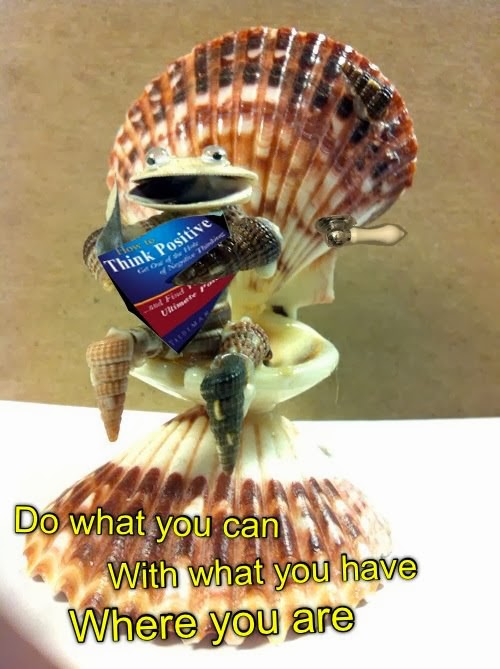
The possibilities are endless.Most of us go through life as failures, because we are waiting for the "time to be right" to start doing something worthwhile. Do not wait. The time will never be "just right." Start where you stand, and work with whatever tools you may have at your command, and better tools will be found as you go along.Do what you can, with what you have, where you are... : )
If you have the excuse that you don't have time to improve yourself, this is what I recommend.
There were times when I thought I couldn't go on, but I forced myself to keep going. I realized that success is greatly based on persistence, not luck.Decide in advance what blocks of time you'll allocate each week to family time, entertainment, exercise, social activities, and personal hobbies. Then schedule your work hours using whatever time is left. This can reduce the urge to procrastinate because you work will not encroach on your leisure time, so you don't have to procrastinate on work in order to relax and enjoy life. I caution against overusing this strategy, however, as your work should normally be enjoyable enough that you're motivated to do it.
No matter how good of a business person you are or how motivated you might be about reaching your goals, there will always be times when you just plain don’t want to get to work. Maybe it’s a big project you’re stalling on at the office or maybe you’re staring down the end of the second week in a row you’ve skipped your gym workouts. Whatever the case, the moral of the story is that you need a way to break through your procrastination – and you need it fast!
When you find yourself stuck in this rut, try any of the following tips to help you overcome procrastination.
Make a List
Start by creating a to-do list with things that you would like to accomplish. If necessary, put a date next to each item if there is a deadline that you need to meet. Estimate how long each task will take to complete, and then double that number so that you don't fall into the cognitive trap of underestimating how long each project will take.
Find the little tricks that motivate you
What is one tiny thing you could do to push yourself toward the action you don’t feel like doing?When I don’t feel like working out, I know the easiest way to get me to do it is to try doing Yoga. When I don’t feel like working on my Defects, thinking about the Time I will have to leave and duration I will have to wait for Cab :) if I don't fix it will make me more in the mood to continue my work .By employing these baby steps, you can often convince yourself you actually do want to finish that project, clean the bathroom or organize a fundraiser. It’s just a matter of taking one step. Sooner or later, you’ll want to put another foot in front of that one.
When you are faced with a big project, you might feel daunted, intimidated, or even hopeless when you look at the sheer amount of work involved. At this point, take individual items on your list and break them down into a series of steps. If you need to write a paper for class, what steps do you need to follow? If you are planning a big family event, what are the things you need to do and what supplies do you need to obtain? Once you have created a list detailing the process you need to go through in order to accomplish the task, you can start working on individual "baby steps."
Ask yourself why
Look deeply into the reason you want to quit. Implore yourself: Why don’t I want to start? Chances are the answer isn’t that you’re being lazy (although those rainy days make it hard for me to get moving), it’s that you’re afraid.Fear of failure, fear of success, fear of criticism. These are huge stumbling blocks for many of us. I had a hard time writing this article; I kept putting it off. It finally dawned on me that I was worried about being criticized.Once I recognized that I was acting out of fear instead of being frustrated with my procrastination, I could take real action. I gave myself a pep talk, reminding myself of previous times I’d written well with minimal, and mostly constructive, criticism.Recognizing when you’re acting out of fear gives you compassion for yourself, giving you the opportunity to move forward instead beating yourself down and holding yourself back.
Recognize triggers that diminish your discipline
It's hard to get any real work done when you keep turning your attention to what's on television or you keep checking your friends Facebook status updates. Assign yourself a period of time during which you turn off all distractions – such as music, television, and social networking sites – and use that time to focus all of your attention on the task at hand.
Focus
This might seem like a no-brainer, but I can’t tell you the number of times I just forget to focus. I’ll be in the middle of writing and suddenly I’ll be reading a blog post. Or mucking around on FaceBook. How did I get here, I wonder.
When I notice myself doing this, I say the word outloud. “Focus.” Often that’s all it takes for me to return to the task at hand with renewed vigor. Giving yourself a command out loud tends to wake you up a little.
Envision yourself being finished with the task
This one works great for me if I’m really struggling. Generally I’m one of those people who will finish something once I start, so if I’m entertaining the idea of quitting half-way through, I know I need to play some mind games :).
During a particularly grueling workout, I really considered calling it quits. I had worked hard enough, I told myself. I took a minute and saw myself eating a big chocolate Ice Cream ,Listening to Rock n Roll. It did the trick.
See yourself celebrating after you finish a project at work. Peer into your mind’s eye and you’ll find you’re enjoying a good book in your newly painted living room. Often this is just the thing to get you moving in the right direction.
Get to know your willpower
Willpower is a critical part of discipline, although they aren’t exactly the same thing. Discipline is what gets you out of bed every morning to train for that marathon. Willpower is what you need when you had a bad night’s sleep, it’s cold and your bed couldn’t be cozier.
We all have a power source within us that can push us beyond what we thought we were capable of. It’s how we push through a hard day at work when we know we can’t take time off.
Or how we skip the beautiful dessert tray at a decadent restaurant.
Pay attention to when you draw on this source. When does it work best for you? When do you feel it wane? I find that my will power is strongest in the morning, so that’s when I schedule things I know I’ll need a little push to get through.
Your willpower is a valuable resource, so get familiar with it. Maybe it struggles if you’re hungry. You could keep some healthy snacks on hand to get you through difficult times. View it as one of your closest friends. Treasure it, nurture it and you’ll be able to count on it down the line.
As you start to tackle items on your list, pay attention to when thoughts of procrastination start to creep into your mind. If you find yourself thinking "I don't feel like doing this now" or "I'll have time to work on this later," then you need to recognize that you are about to procrastinate. Instead of giving into the urge, force yourself to spend at least a few minutes working on the task. In many cases, you might find that it is easier to complete once you get started.
Remember: If it was easy, everyone would be good at it
Make this your mantra. What you’re doing is extremely difficult, so try to be as understanding as you can with yourself.When I’m pushing my limits, I notice I get really crabby and angry at myself. I should be able to handle this, I think. That’s when I know it’s time to have a heart-to-heart with my brain. I’m allowed to make mistakes. I’m allowed to take time off. This isn’t easy.Be kind to yourself, especially when first starting on your journey toward improving your discipline. It’s a long road, and if you start out by putting yourself down, you’re not going to make it very far. Hard work is hard work. Don’t make it more difficult with negative self-talk.
Discipline is one of those fundamental skills that make life easier and can help your dreams come true. The more you sharpen it, the better that tool will become. Over time, you’ll be able to do anything you set your mind to.Keep in mind that everything you procrastinate today only compounds tomorrow’s pressure. To be motivated toward your goal requires you to have strong “motive” and move. Decide what you want. What tasks must be done in order for you to accomplish your goals, dreams and aspirations? Act now. Don’t wait another day. The future is now.